Showing posts with label Task 1. Show all posts

Saturday, February 5, 2022

Introduction to my IELTS Academic Writing Blog

I scored an overall 8.5 band score in the IELTS Academic exam. The IELTS exam consists of four modules. My scores were:
  • ✎ Listening - 9
  • ✎ Reading - 8.5
  • ✎ Writing - 8
  • ✎ Speaking - 8

I also graduated with a Bachelors Degree in Canada, where I have been residing for over a decade.

If you're planning to immigrate, read about my Permanent Residency timeline here.

In my Writing Blog, I will be explaining how to attempt the question, what key points can be included in the main body, and most importantly, how to write its introduction! I will also be posting solutions to various graphs and essays from Task 1 and Task 2, respectively.

For the Academic students, Task 1 is a graph and Task 2 is an essay.
However, for the General Training students, Task 1 is a letter while Task 2 is an essay.

The Writing module is divided into Task 1 (3 bands) and Task 2 (6 bands).

You would be getting 60 minutes for the writing module. In these 60 minutes, the ideal time to attempt Task 1 is around 18 minutes, and for Task 2, it is 35 minutes (a total of 53 minutes). You should use the remaining 7 minutes for proofreading and corrections.

Use the following two links to review Task 1 and 2 Sample Solutions!

IELTS Task 1 (Graphs) Sample Solutions

IELTS Task 2 (Essays) Sample Solutions

Tuesday, January 25, 2022

IELTS Task 1 - Vertical Bar Graph: Men and women in further education in Britain

WRITING TASK 1

You should spend about 20 minutes on this task.

The chart below shows the number of men and women in further education in Britain in three periods and whether they were studying full-time or part-time.


Summarise the information by selecting and reporting the main features, and make comparisons where relevant.


The chart below shows the number of men and women in further education in Britain in three periods and whether they were studying full-time or part-time.

The vertical bar chart illustrates the number of men and women in further full-time and part-time education in Britain from 1970 to 1990. The data is reported in thousands.

From an overall perspective, it is apparent that the number of men and women pursuing full-time education has steadily increased over two decades. While there were twice as many men as women in 1970, women surpassed enrollment figures a decade later. It is notable that by 1990, both men and women reported equal numbers at nearly 300 thousand.

Upon closer observation of part-time pursuing student trends, it is interesting that while full-time male students had a steady rise over two decades, part-timers had a gradual decline and reported a loss of about 100 thousand students. On the flip side, female students had an exponential growth by 1990 and, combined with their full-time counterparts, accounted for the highest number of students enrolled in further education overall.

To summarize, from a trend perspective, full-time and part-time student numbers have swelled up over two decades.

IELTS Task 1 (Graphs) Sample Solutions

IELTS Task 2 (Essays) Sample Solutions

IELTS Task 1 - Pictorial Chart: Development of the village of Chorleywood, London


The map shows the development and increase in the population of Chorleywood, a village near London, between 1868 and 1994.

Chorleywood's transit system was developed in a tic-tac-toe gridlike pattern. Chorleywood Park and Golf Course is the central point. The Chorleywood station to the south of Chorleywood Park was the first to be developed between 1883 and 1922. During this development, the Railway was built in 1909. The dark shaded area around the station was developed between 1922 and 1970.

After the station's surrounding expansions in 1970, the Motorway was established to the West of the Park and Golf course. As depicted in the chart using diagonally shaded areas, we notice new expansions from 1970 to 1994. It is worth noting that all areas intersect with at least two modes of transportation.

Overall, it is evident that as the population steadily increased, the village of Chorleywood had significant developments over a span of a century.

IELTS Task 1 - Vertical Bar Graph: Student enrollment in Ahmadu Bello University, Nigeria

The vertical bar graph depicts the number of male and female students enrolled in six different courses in Ahmadu Bello University, Zaira, Nigeria.

The six courses in order of overall signup numbers are - Engineering, Language/Education, Arts, Science, Computing and Medicine/Pharmacy. From a broad perspective, it is noticeable that the maximum male students enrolled for Engineering with 520 admissions. Meanwhile, female students preferred Language/Education at 450. While Engineering had less than half female enrollment, we observe a similar trend for men in Language/Education.

Moving further, the least preferred course for both men and women was Medicine/Pharmacy at 80 and 50. Computing and Sciences fared slightly better but remained the bottom three choices amongst the six courses. Female registration in Arts and Engineering was approximately similar. One hundred fifty male students enrolled for Science while females enrolled at 20 less than males.

In a nutshell, maximum male and female enrollment were in Engineering and Language/Education respectively.

IELTS Task 1 - Vertical Bar Graph: Weekly leisure hours for men and women

The vertical bar chart portrays the number of hours of leisure enjoyed by men and women in a typical week in 1998-99, according to gender and employment status. The data is calibrated in hours.

From an overall perspective, it is apparent that among those employed full-time, men on average had 50 hours of leisure, whereas women had approximately 37 hours. There were no figures for male part-time workers, but female part-timers had 40 hours of leisure time, only slightly more than women in full-time employment, perhaps reflecting their work in the home.

Stating further, as expected, both unemployed and retired people relished upwards of approximately 90 leisure hours per week, closely followed by females at about 80. Lastly, female homemakers enjoyed approximately 54 hours of leisure, while no figures were reported for their male counterparts.

Overall, for the reported categories, men enjoyed slightly more leisure time than women.

IELTS Task 1: Vertical Bar Graph: Home activities among young children in four countries

The vertical bar graph depicts four different home activities among young children in Malaysia, China, Nigeria and Sudan. The data is calibrated in percentage.

From an overall perspective, it is apparent that Computer Games are the most popular home activity in all four countries, with Nigerian kids preferring it the most at 60%, closely followed by Malaysian and Sudanese at 50% each. Comparatively, only 40% of Chinese kids prefer games. It is also noticeable that watching TV is equally preferred at 30% in all four countries.

Moving further, it is evident that the least popular home activity is Reading, with a 20% preference in Malaysia and a mere 10% for both Nigeria and Sudan. Sudanese children report a 30% choice for board games, followed by 25% for Malaysia and China.

Overall, Computer Games are the most popular and Reading is the least preferred home activity in all four countries.

Note!: Since there is no mention of the year in the given graph, you may use the present tense or the past tense.
Either of them would be correct.
However, a few people may believe that since the survey has already been taken, the past tense should be used. If that is the case, you may write this in the past tense for your own satisfaction. :)

IELTS Task 1: Table Chart: Cosumer durables owned in Britain

WRITING TASK 1

You should spend about 20 minutes on this task.

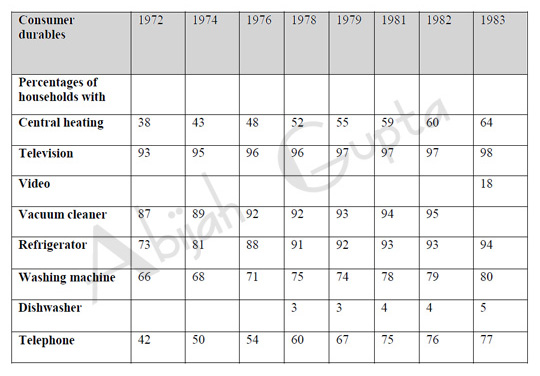
The table below shows the consumer durables (telephone, refrigerator, etcetera) owned in Britain from 1972 to 1983.


Summarise the information by selecting and reporting the main features, and make comparisons where relevant.


consumer durables owned in Britain
The tabular graph illustrates the percentage of British households who owned a range of consumer durables between 1972 and 1983.

The most significant increase was telephone ownership, rising from 42% in 1972 to 77% in 1983. At 98%, almost all households owned a Television by 1983, closely followed by Refrigerators at 94%. Unlike its counterparts, the least popular durable was a Dishwasher, stagnating at an average of 5% between 1978 and 1983.

In 1983, with the introduction of Video equipment, 18% of households reported ownership. Over nine years, the proportion of British houses with central heating rose from one-third to nearly two-thirds. In the reported period of less than a decade, an increased purchasing power fueled by affordability and relentless marketing strategies could have led to the visibly significant increases in the ownership of all reported consumer durables.

To summarize, it is apparent that the percentage of durables ownership increased over the years.

IELTS Task 1 (Graphs) Sample Solutions

IELTS Task 2 (Essays) Sample Solutions

IELTS Task 1 - Graphs - Sample Answers


The ideal time to attempt Task 1 is around 18 minutes.
 

Since Task 2 is worth 6 bands, it is important to be able to scan important details from the question quickly and start writing!


Use the following links to navigate through solved Task 1 questions:


Vertical Bar Graph

Question 1: Oil production by Gulf countries
Question 2: Favourite pastime activities by young children
Question 3: Fertility rate for Gulf countries
Question 4: Internet usage by age
Question 5: Home activities among young children in four countries
Question 6: Weekly leisure hours for men and women
Question 7: Student enrollment in Ahmadu Bello University, Nigeria
Question 8: Men and women in further education in Britain

Horizontal Bar Graph

Question 1: Consumer good spending by country
Question 2: Freedonia employment by sex

Line Graph

Question 1: India's gold sales in 2020
Question 2: London underground station passengers
Question 3: Tooth decay by sugar consumption
Question 4: Wheat export for Canada, Australia and European Community
Question 5: Canadian fast food consumption
Question 6: Cinema attendance in the UK by age

Pictorial Graph

Question 1: Central heating system in a house
Question 2: The Eiffel Tower and expansion plans
Question 3: The Hawaiian island chain 
Question 4: The Australian Bureau of Meteorology's weather forecast process
Question 5: Development of the village of Chorleywood, London

Pie Chart

Question 1: Population, resources and global spending
Question 2: USA - Energy Sources in 2000 and 2010

Table Chart

Question 1: Favourite pastimes by countries
Question 2: UK Residents travel abroad to Western Europe and North America
Question 3: Consumer durables owned in Britain

Flow Chart

Question 1: Plastic paper clips production process

Blend Chart

Question 1: Pie & Line - Food budget spent on restaurant meals and home cooking
Question 2: Horizontal & Pie Chart: Adult education and cost sharing
Question 3: Vertical & Line Chart: Weekly fast food consumption trend in Britain 

Monday, January 24, 2022

IELTS Task 1 - Pictorial Graph: The Australian Bureau of Meteorology's weather forecast process


The pictorial graph illustrates the weather forecasting process used by the Australian Bureau of Meteorology to produce reliable forecasts.

It is clear from the graph that mainly four steps are involved in the process - Collecting incoming information, analysis & forecasting, preparing the broadcast, and streaming the broadcast. The first stage gathers the incoming information via satellite, radar, and the drifting buoy.

The second stage examines and forecasts the weather based on the previously collected information—this stage processes all data from satellite imagery, radar screen readings and the synoptic chart. Eventually, the compiled data is fed into a computer to prepare the final broadcast.

Once the data is compiled, processed and edited, it is broadcast to the public in the form of weather updates by the TV newsreader, radio news bulletins or as a recorded announcement over the phone.

IELTS Task 1 - Vertical & Line Chart: Weekly fast food consumption trend in Britain


The vertical bar graph depicts the expenditure on fast foods by different income groups in Britain, and the line graph shows the trends in consumption of fast foods from 1970 to 1990.

The first graph shows that high-income earners consumed considerably more fast foods than the other income groups. They spent more than twice as much on hamburgers (43 pence per person per week) as on fish and chips or pizza (both under 20 pence). Average income earners spent 33 pence per person per week on hamburgers, which was the maximum they spent on any given fast food.

Furthermore, low-income earners spent less than other income groups on fast foods, though fish and chips remained their most popular fast food, followed by hamburgers and pizza. From the line graph, in 1970, fish and chips were the most popular fast food whereas burgers and pizza were the least popular.

Overall, there was a sharp rise and gradual decline in the consumption of hamburgers, pizza, and fish and chips respectively over the 20 years.

IELTS Task 1 - Horizontal & Pie Chart: Adult education and cost sharing


The horizontal bar graph and pie chart depict why adults choose to study and how the adults think the cost of each course should be shared.

From an overall perspective of the horizontal bar graph, it is clear that the main reasons why adults opted for the higher study were because of interest in the subject and to gain qualifications. Approximately 20% studied further because it was either helpful for their present job or improved their promotion prospects.

The same percentage also studied because they enjoyed learning. Around 12% chose to pursue education to change jobs. The least popular reason at 9% was to meet new people.

From the pie chart, we can infer that people think that individuals should spend only 40% of their fees for higher education, while the employer should cover 35% and the taxpayer should pay 25% of their course fees.

Sunday, January 23, 2022

IELTS Task 1 - Pictorial Chart: The Hawaiian island chain


The pictorial chart illustrates the Hawaiian Island chain located in the center of the Pacific Ocean and explains the process of new volcano formations.

The archipelago contains eight significant islands - Niihau, Kauai, Oahu, Molokai, Lanai, Maui, Kahoolawe and Hawaii. The oldest volcano from the chain began to form nearly 80 million years ago. Each island evolved after an eruption on the seafloor, as deep as 2,883 km below the ocean bed. A static 'hot spot' spume pushed magma upwards. Eventually, young volcanoes were formed with the build-up of numerous eruptions.

The Pacific tectonic plate moves in a north-west direction across the Pacific Ocean at a speed of 7-9 cm per year. In a process that takes millions of years, the plate continues to shift slowly and steadily. The eruption process continues to shoot up magma, leading to ongoing eruptions and forming new volcanoes.

IELTS Task 1 - Pictorial Graph: The Eiffel Tower and expansion plans


The two pictorial charts illustrate the Eiffel Tower in Paris and the outlined project for its underground extension.

The Eiffel Tower is located on the banks of the Seine River and right next to the Ecole Militaire in Paris. Five levels will be developed underneath the structure per the outlined project. Starting from the bottom two levels (fourth and fifth), visitors would park their vehicles and use the two vertical lifts to access all other floors. The third level will contain a cinema and museum for entertainment. The second level will include multiple shops and restaurants. Finally, the top-level will house the ticket office to grant access to the tower.

The structure spans 324m vertically and weighs 10,100 tonnes from the main level. The first viewing platform is at the height of 57m, and the next is 1665 steps above at 115m.

FREE IELTS Writing Practice Graphs and Essays - E-books


I am in the process of updating the previously released Ebooks. To get the most up-to-date solved answers, please refer to the following two links for now:

IELTS Task 1 - Vertical Bar Graph: Favourite pastime activities

WRITING TASK 1

You should spend about 20 minutes on this task.

The chart below shows the favourite pastime activities for young children.


Summarise the information by selecting and reporting the main features, and make comparisons where relevant.


The vertical bar graph reveals the preferred leisure activities of children aged 5-14. The data is calibrated in percentage.

Out of the children surveyed, it is apparent that watching TV or videos was the most preferred leisure activity. In addition to it, the second most popular activity, preferred by 80% of boys and 60% of girls, was playing electronic or computer games.

Girls rated activities such as art and craft at approximately 60%; however, only 35% of boys opted for creative pastimes. On the other hand, bike riding was almost as popular as electronic games amongst boys and nearly 60% of girls.

Only 25% of the girls voted for Skateboarding as their favourite pastime, making it the least popular amongst girls; however, it attracted the same amount as Art & Craft for boys.

Overall, watching TV or videos was the preferred pastime for both boys and girls.

IELTS Task 1 (Graphs) Sample Solutions

IELTS Task 2 (Essays) Sample Solutions

IELTS Task 1 - Line Graph: London underground station passengers

WRITING TASK 1

You should spend about 20 minutes on this task.

The chart below shows the number of people using the London underground station.


Summarise the information by selecting and reporting the main features, and make comparisons where relevant.


london underground station passengers
The line graph depicts the fluctuation in the number of people at a London underground station over a day.

From an overall perspective, it is crystal clear that the busiest time is in the morning. There is a sharp increase between 06:00 and 08:00, with 400 people using the station at 8 o'clock. After this, the numbers drop quickly to less than 200 at 10 o'clock. The number rises between 11 am and 3 pm, with a plateau of just under 300 people using the station.

Moving further, in the afternoon, numbers decline, with less than 100 using the station at 4 pm. There is then a rapid rise to a peak of 380 at 6 pm. After 7 pm, numbers fall significantly, with only a slight increase again at 8 pm, tailing off after 9 pm.

Overall, it can be inferred that the station is most crowded in the early morning and early evening periods.

IELTS Task 1 (Graphs) Sample Solutions

IELTS Task 2 (Essays) Sample Solutions

IELTS Task 1 - Vertical Bar Graph: Oil Production by Gulf Countries

WRITING TASK 1

You should spend about 20 minutes on this task.

The chart below shows the oil production for six Gulf countries from '90 to '10.


Summarise the information by selecting and reporting the main features, and make comparisons where relevant.


oil production for six Gulf countries from '90 to '10
The vertical bar graph depicts the oil production in millions of barrels per day for six Gulf countries.

From an overall perspective, it is noticeable that almost all countries' oil production had increased from 1990 to 2010. Saudi Arabia noticed the most significant rise where the production increased from 8.2 in 1990 to 14.2 in 2010. Out of all the six countries, Saudi Arabia's output remained the highest. Iran was in the second position in terms of oil production. Its oil production in 2010 was 4.2 while the figure was 1.5 less in 1990.

Iraq and UAE have similar profiles, and their production figures have been similar over the four years. Iraq and UAE's production in 2010 was approximately 2.7.

Qatar remained the lowest producer of oil with an average production of 0.2, with an exception in 2000 where the production was 0.4

In a nutshell, it is crystal clear that Saudi Arabia has always been the maximum producer of oil while Qatar has been the lowest.

IELTS Task 1 (Graphs) Sample Solutions

IELTS Task 2 (Essays) Sample Solutions

IELTS Task 1 - Vertical Bar Chart: Internet usage by age

WRITING TASK 1

You should spend about 20 minutes on this task.

The chart below shows the internet usage by age for the years 1998 to 2000.


Summarise the information by selecting and reporting the main features, and make comparisons where relevant.


internet users by age

The vertical bar graph depicts the changes in the age profile of Internet users between 1998 and 2000. The data is reported in percentage.

Overall, the primary users of the Internet were young adults between 16 and 30 years old. In 1998, they accounted for more than half of all users. Even though usage dropped by 9% within two years, they continued to be the most prominent group.

The second biggest group of Internet users aged between 31 and 50 reported a 41% usage in 1998, falling slightly to 37% in 2000. When combined with the 16-30 age group, over 94% of users in 1998 were between 16 and 50. In 1999, the number of children online quadrupled from 2% to 8%, and it continued to increase in 2000. There were similar increases for older users, rising from 4% in 1998 to 10% in 2000.

Overall, users between the ages of 16 and 50 accounted for most Internet users.

IELTS Task 1 (Graphs) Sample Solutions

IELTS Task 2 (Essays) Sample Solutions
IELTS Task 1 - Pie & Line Chart: Food budget on restaurant and home cooking

WRITING TASK 1

You should spend about 20 minutes on this task.

The charts below show the percentage of food budget spent by an average family on restaurant meals in different years. It further shows the number of meals for fast food vs. sit-down restaurants.


Summarise the information by selecting and reporting the main features, and make comparisons where relevant.


Restaurants vs. home cooking

The pie chart and the line graph reveal the percentage of food budget spent on restaurant meals, home cooking and the number of meals per year from 1970 to 2000. The data is calibrated in percentage.

Overall, the percentage of the average family's food budget spent on restaurant meals steadily climbed. Families spent just 10 percent of the food budget on restaurant meals in 1970, which increased to a staggering 50% by 2000.

In 1970, families ate the same annual meals at fast food and sit-down restaurants. Two decades later, fast food restaurants served more meals to families than sit-down restaurants. In 2000 the percentage of fast food meals reached the pinnacle at almost 90%, while the ratio for sit-down restaurant meals was approximately half.

Overall, home cooking has steadily declined, and fast food meals have become the staple choice.

IELTS Task 1 (Graphs) Sample Solutions

IELTS Task 2 (Essays) Sample Solutions

IELTS Task 1 - Line Chart: Cinema attendance in the UK by age

WRITING TASK 1

You should spend about 20 minutes on this task.

The chart below shows the cinema attendance in the UK.


Summarise the information by selecting and reporting the main features, and make comparisons where relevant.


cinema attendance in the UK

The polyline graph depicts the percentage of people who went to the movies in the United Kingdom between 1990 and 2010. The data ranges from age 14 to 54.

Overall, all four age groups showed a gradual and similar increase in attendance numbers during the given period, except for a slight drop between 1995 and 2000. It is noticeable that although groups 44-54 and 34-44 started at nearly the exact attendance, the former group displayed the most growth in a span of two decades.

Moving further, for the age group 24-34, the reported attendance between 2005 and 2010 stagnated while other groups showed an uptrend. Group 44-54 started at only 38% in 1990 but steadily climbed to 50% by 2010, thus displaying a leading growth of 12%. Group 14-24 reported the smallest increase at about 5%.

Overall, the maximum cinema attendance in the UK was and remained to be in the 44-54 age group.

IELTS Task 1 (Graphs) Sample Solutions

IELTS Task 2 (Essays) Sample Solutions